
gap FLY FISHING trips

UNIQUE EXPERIENCES










FLY FISHING IN THE FRENCH ALPS

FLY FISHING IN THE CENTRAL MASSIF

FLY FISHING IN THE FRENCH PYRENEES

BROWN TROUT

Salmon
10 BEST PLACES FOR FLY FISHING
France, located in Western Europe, covers a diverse geography ranging from the majestic Alps and Pyrenees to the vast plains of the Champagne region. This varied geography and the presence of large mountain ranges make it a privileged destination for fans of wild and native trout fishing. If you are looking for information on Fly Fishing in France, these 10 places will interest you:

1- HAUTES ALPES DEPARTMENT
The Hautes Alpes, located in the Provence-Alpes-Côte d’Azur region of France, are renowned for their breathtaking mountainous landscapes and national parks such as Ecrins and Queyras. Its capital, Gap, not only possesses a prominent historical and cultural heritage but also serves as the perfect focal point for a fishing vacation in the region.
In this department, you can pursue brown trout, rainbow trout, brook trout, Arctic char, and grayling. The diversity of watercourses in the Hautes Alpes, encompassing 1700 km of first-category waters, 300 km of second-category waters, 3200 hectares of lakes and reservoirs, and 48 high-altitude lakes, allows for diverse fishing experiences. Standout fishing areas include the Clarée Valley, near Briançon and Montgenèvre, a natural site classified for its exceptional landscapes and preserved heritage. The 32 km-long Clarée River offers abundant fly fishing opportunities, including two “No Kill” stretches. Other notable rivers include the Guisane, with its robust flow suitable for various techniques, the Guil, ideal for fly fishing, and the Durance, the department’s main river with a length of 324 km and “NO KILL” sections in Briançon. The Cerveyrette, a 23 km mountain torrent, is conducive to dry fly fishing in the summer.

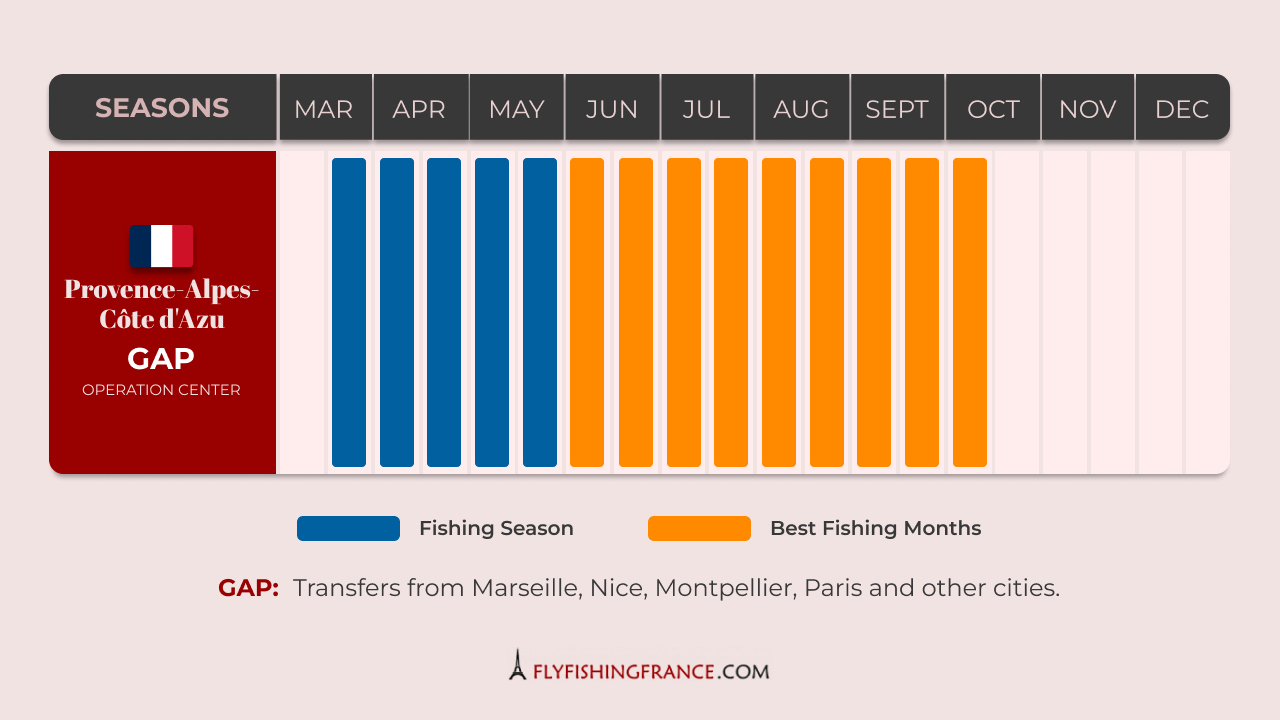
- Season: The fly fishing season in the Hautes-Alpes typically spans from the third week of March until the end of September, with the prime months being from June to September.
- Fishing license: Fishing in the public rivers of the Hautes-Alpes requires a fishing license, which grants access to regulated fishing areas. To obtain the fishing license for the Hautes-Alpes, you can conveniently make a purchase through the website of the Fédération de pêche des Hautes-Alpes or via the website of the carte de pêche.
- Best rivers: The waters housing trout in the Hautes-Alpes are classified as first-class waters, divided into mountain lakes and rivers – streams.
- Fishing in mountain lakes of the Hautes-Alpes: The Hautes-Alpes department presents an incredible opportunity for mountain and hiking anglers, boasting around fifty lakes that are perfect for fishing. Situated between 1800 m and 2800 m above sea level, these lakes are classified under the 1st fish category, ensuring an exceptional fishing experience. These high-altitude lakes are scattered across various geographical areas within the department, including Champsaur, Valgaudemar, Embrumais, Queyras, Vallouise, Freissinnière, Roche de Rame, Ecrins, and Briançonnais. Among the must-visit lakes, we highly recommend Grand Laus, Mézan, and Petit Laus.
- Fly fishing rivers in the Hautes-Alps: The rivers of the Hautes-Alpes, such as Champsaur, Queyras, Durance, Guil, and Buëch, offer excellent opportunities for fly fishing, making it one of the premier destinations for this activity in France. In these glacial meltwater rivers and springs of pristine and untamed waters, the wild Zebra trout thrives, providing a unique and captivating fishing experience. The Durance, one of Provence’s most significant rivers, is home to wild brown trout of medium to large sizes. On the other hand, the Guil boasts impressive trout and char, with its distinctive environment characterized by strong currents and rocky gorges. As for the Buëch, surrounded by pine trees and lavender fields, it is particularly ideal for early-season fly fishing, providing anglers with an unforgettable experience amidst breathtaking natural beauty.
- Species: Brown trout, zebra trout, rainbow trout, and char.
- Size of trout: Generally, the trout in these mountain rivers tend to be of small and medium sizes. Due to the alpine nature of the rivers, larger trout are not commonly found. However, there are exceptions, and certain medium-sized rivers and lakes offer opportunities to catch larger trout.
- Type of fishing: During the best months of the season, anglers can enjoy daily fishing with dry flies, providing an exciting experience. Additionally, nymph fishing remains highly effective throughout the year.
- Contact with the fishing federation: We highly recommend visiting the website https://peche-hautes-alpes.com/. On this page, you will discover essential information such as fishing regulations, fishing areas, fishing courses, season opening and closing dates, and even webcams showcasing the rivers for an enhanced fishing experience.
2- ALPES-MARITIMES DEPARTMENT
Alpes-Maritimes is a French department located in the Provence-Alpes-Côte d’Azur region in the southeast of France. Renowned for its spectacular mountainous landscape and proximity to the Mediterranean Sea, it offers a unique blend of Alpine charm and Mediterranean climate. The region is home to cities such as Nice and Cannes, famous for their beauty, beaches, and cultural events.
The four most famous rivers for fly fishing in this department are:
-
- La Siagne river: La Siagne, a coastal river in France, partially marks the border between the Var and Alpes-Maritimes departments. Classified as a first-category river up to the Tanneron bridge, this karstic river is exceptional for trout fishing, featuring rapids and deep pools along its course. The high Siagne Gorges offer a wild landscape, while the Siagne bridge area is accessible and has an interdepartmental fishing route.
-
- Le Loup river: The Loup River spans 35 km in the first category, with an excellent population of wild brown trout in its upper part. Originating from karstic springs in the Audibergue massif, it flows into the Mediterranean Sea. Various fishing techniques are practiced, including nymph fishing at the beginning of the season and fly fishing as temperatures drop. In the upper Loup, you’ll find populations of brown trout and southern barbel, while downstream, common trout, chubs, and other cyprinid species are added. Key access points include Pont de Cipière and Gorges du Loup.
-
- Le Var river: The Var River in Alpes-Maritimes, spanning 114 km from Estenc to the Mediterranean, is classified as the first category up to Carros. It offers diverse fishing, from trout to chub. The Daluis Gorges are notable, and the “moyen Var” is suitable for fishing in rapids and deep pools. The lower stretch has various species, but fishing is prohibited in a birdwatching area. Managed by several associations, the river hosts brown trout and southern barbel.
-
- La Gordolasque river: The Gordolasque, the main tributary of the Vésubie, is an exceptionally beautiful river in Alpes-Maritimes known for being an excellent setting for dry fly fishing and its fish density. Following the storm Alex in 2020, fishing remained closed until 2023, especially in the Gordolasque. The upper area presents an Alpine landscape, while the lower, separated by the Ray waterfall, offers waterfalls and varied fishing. Managed by the AAPPMA “La Gordolasque,” this river is home to brown trout and some brook trout in its tributaries.
It’s also important to note that in this department, there are excellent mountain lakes for fly fishing, located above 1,800 meters in altitude. Among all the lakes, those in Vésubie or Tinée in the Mercantour stand out.
3- GUADELOUPE DEPARTMENT
Guadeloupe, an overseas French department in the Caribbean archipelago, stands out for its extensive protected spaces and marine nature reserves. Comprising two main islands, Basse-Terre and Grande-Terre, along with several smaller islands, Guadeloupe boasts white sandy beaches, tropical rainforests, and coral reefs, providing a unique blend of natural and cultural diversity.
In this country with a rich Creole culture, it is a paradise for saltwater fishing enthusiasts, offering the opportunity to catch a wide variety of predatory fish such as barracudas, jacks, snappers, tarpons, snooks, mackerels, tunas, and sharks. For those not inclined towards fishing, Guadeloupe provides a wide range of sports and cultural activities.
For fly fishing enthusiasts, it is a haven with shallow mangrove waters and numerous flats. Here, anglers can pursue mythical species like Bonefish, snook, tarpon, and permit, presenting the chance to achieve the coveted Grand Slam. This destination has nothing to envy from other well-known locations such as Mexico, the Bahamas, or Cuba.
4- VOSGES DEPARTMENT
The Vosges is a French department located in the northeastern part of the country. It takes its name from the Vosges mountain range, which serves as a natural border between the Alsace and Lorraine regions.
Between the Rhine basin and the Vosges mountain range lies the Alsace region, whose foothills are a paradise for fly fishing, especially for trout and grayling. The region offers diverse fishing opportunities, whether with dry flies, nymphs, streamers, or wet flies. Dry fly fishing is possible almost throughout the season, from March to October, thanks to regular insect hatches. The best fishing opportunities include fly fishing for trout in the Fecht, Vologne, or Bruche rivers from March to September, and grayling fishing in the Bruche, Moselle, and Moselotte rivers from June to November.
5- SAVOY DEPARTMENT
The Savoy department, located in the Auvergne-Rhône-Alpes region, is in southeastern France, sharing its borders with Italy. Renowned for its breathtaking Alpine landscapes featuring majestic peaks and crystal-clear lakes such as Lake Bourget, Savoy is home to famous ski resorts and mountain villages like Chambery.

Season: The fishing season typically commences on March 11 and concludes on October 8. The prime fishing months are from mid-March to early June, late July to early September, mid-October, and late October.
Fishing license: To partake in recreational fishing in the open waters of France, it is necessary to join a fishing association (AAPPMA) and obtain a fishing license from them. One-day licenses are priced at €15, one-week licenses at €34, and year-round licenses at €95. These licenses can be purchased on the website savoiepeche.com.
Species: In this Alpine department, you can fish for brown trout, brook trout, grayling, and rainbow trout.
The top 5 fly fishing rivers:
River Guiers in St. Béron:
-
- Management: AAPPMA de Pont-de-Beauvoisin / La Bridoire – Guiers / Tier.
-
- Features: First-category stretch with fast-flowing areas and pools. Wooded banks and unpredictable results.
-
- Species: Brown trout, common grayling, rainbow trout, chub, and barbel.
-
- Tips: Recommended for experienced anglers. Use of flies, especially in late August. Pay attention to spring flow due to thawing.
River Arly in Flumet:
-
- Management: AAPPMA de Flumet – Val d’Arly.
-
- Features: First-category stretch, “catch and release.” Suitable for experienced anglers with rapids, pools, and plains.
-
- Species: Brown and rainbow trout.
-
- Tips: Practicable with various techniques. The river reveals its maximum potential after thaw, typically from July onward.
Doron de Chavière:
-
- Management: AAPPMA de Pralognan La Vanoise.
-
- Features: First-category course on a plateau at 1,725 meters. “Catch and release” with brook trout, rainbow trout, and brown trout.
Doron de Bozel sous Brides-les-Bains:
-
- Management: AAPPMA de Moutiers – La Gaule Tarine.
-
- Features: First-category stretch, rugged and wild. Presence of brown and rainbow trout.
-
- Tips: Requires constant adaptability. Flow is affected by spring thaw.
Parcours Pêche de Savoie “Prendre et Relâcher” in l’Arc à Sollières-Sardières:
-
- Management: Fédération de Savoie pour la Pêche et la Protection des Milieux Aquatiques and the Société de pêche privée de Termignon.
-
- Features: 2.5 km catch-and-release stretch in Haute Maurienne.
-
- Species: Brown trout, common ombre, and rainbow trout.
-
- Tips: Accessible for beginners. Regulation prohibits natural baits. Use of nymphs and artificial larvae recommended. Best time: late August until closure, with considerations for flow in spring and early summer.
Species: Brown trout, zebra trout, rainbow trout, and grayling.
Size of trout: In the Savoie region, there is a great variety of rivers and abundant possibilities for fishing. In the medium-sized rivers, it is common to catch medium and large trout.
Contact with the fishing federation: We recommend visiting the website www.savoiepeche.com/. On this page, you will find essential information, including fishing regulations, fishing zones, fishing courses, season opening and closing dates, and even webcams showcasing the rivers for an enhanced fishing experience.
6- ARDECHE DEPARTMENT
Located between Marseille and Lyon, the Ardèche department is situated in the Auvergne-Rhône-Alpes region. This department is renowned for its stunning landscapes, including the Ardèche Gorges and the Regional Natural Park of Monts d’Ardèche. Home to charming medieval villages like Balazuc and Vogüé, as well as cave art sites such as the Chauvet-Pont-d’Arc Cave, the region offers a unique blend of history, nature, and fly fishing.
This area is highly mountainous and features numerous rivers, as it is located in the Massif Central. The French Massif Central is an extensive mountain range in the center of France, characterized by mountainous landscapes, plateaus, and valleys. The rivers of the Massif Central flow into the Mediterranean Sea. Therefore, the queen of its rivers is the Mediterranean striped trout, also known as zebra trout.
The best places for fly fishing in this department are the catch-and-release stretches of rivers, including L’Ardeche Amont, L’Ay, La Beaume, La Haute Canc, La Cance et la Deume, La Dorne, Le Doux, La dobre, and more. If you are interested in exploring all the “no-kill” stretches in the department, I recommend checking the following link: https://www.peche-ardeche.com/parcours-de-peche-sans-tuer.html
7- HAUTE-SAVOIE DEPARTMENT
Haute-Savoie, located in the Auvergne-Rhône-Alpes region in eastern France, presents exceptional fly fishing opportunities, making it an idyllic destination for those seeking to immerse themselves in the natural beauty of the French Alps while indulging in a unique fishing experience.

Season: The fly fishing season in Haute-Savoie extends from the end of March to the beginning of October. The prime months for fly fishing are March, April, and from mid-June to the end of September.
Fishing license: To fish in Haute-Savoie, acquiring a suitable fishing license is essential. You can opt for either an annual or tourist card available through various fishing associations in the region. The license, known as “Carte de Pêche” in France, can conveniently be purchased on the website http://www.cartedepeche.fr.
Best rivers: While the rivers in Haute-Savoie are public, access to some areas may be private. The most sought-after rivers in Haute-Savoie are the ones teeming with trout, earning them the prestigious label of “first class” waters. Among these top-tier rivers, the finest ones include:
- The Fier, a renowned river in Haute-Savoie, stretches 71 km long, originating from Mont Charvin and coursing through awe-inspiring valleys and gorges. It is primarily fed by rainwater and snowmelt in Thônes, Annecy, and Rumilly. The Thônes sector stands out as an enticing location for brown and rainbow trout fishing, boasting abundant fish density within accessible rapids and pools, notably between the Tronchine and Chamossière bridges.
- The Fillière, a first-class river and tributary of the Fier, spans 24 km in length. Historically abundant in insect hatches, the river’s insect population has diminished over time, impacting the density of brown trout. Upstream of Usillion, the pristine environment supports a healthy population of modest-sized fish. As the river flows downstream to Groisy, larger brown trout can be found. From Charvonnex to the river’s mouth, anglers may also encounter trout, along with a respectable population of barbel and chubs.
- The Chéran, a 54 km long river originating from the Bauges massif in Savoie and joining the Fier in Haute-Savoie, has earned a place among France’s ten most beautiful rivers. This stunning waterway features breathtaking landscapes and is home to a thriving population of zebra trout. For fly fishing enthusiasts, we highly recommend exploring the Boussy run, situated near Rumilly, which has a NO-KILL policy, ensuring sustainable fishing practices.
- Other famous rivers in the region are: Arve river, Borne river, La Diosaz ravine, L’Eau Noire, Le Maleve, Le Bon Nant.
- Among the mountain lakes recommended for fly fishing, the following are worth mentioning: Lake Pormenaz, Lake d’Anterne, Lake Brevent, Lake Vert, Lake Fontaine and Lake Darbon.
Species: The Haute-Savoie waters boast a diverse range of species that appeal to fishing enthusiasts. Among them, you can find Brown trout, Zebra trout, brook trout, Rainbow trout, Cristivomer trout, grayling, chub, and pike.
Size of trout: Generally, the trout in these mountain rivers tend to be of small to medium sizes. While large trout are not common, there are exceptions, and certain medium-sized rivers and lakes offer opportunities to catch larger trout.
Type of fishing: At the beginning of the season, fishing primarily involves nymphs, except during the middle of the day. As summer arrives, fishing shifts to dry flies, nymphs, and tandems to yield successful results.
Contact with the fishing federation: We highly recommend visiting the website www.pechehautesavoie.com/. This comprehensive platform provides essential information such as fishing regulations, fishing areas, fishing courses, season opening and closing dates, and even webcams showcasing the rivers for an enhanced fishing experience.
8- ATLANTIC PYRENEES DEPARTMENT
The Atlantic Pyrenees Department is situated in the Nouvelle-Aquitaine region, located in southwestern France along the border with Spain. Renowned for its fusion of Basque-French traditions, stunning mountain landscapes, and notable peaks like Midi d’Ossau, this department offers a unique cultural and natural experience.
In addition to its cultural richness, the department boasts more than 5,200 kilometers of prime fishing grounds, encompassing a variety of rivers, streams, and mountain lakes. Key species include brown trout, Atlantic salmon, and eel.
Notable rivers for trout fishing include the Gave d’Ossau, Gave d’Aspe, and Le Saison. It’s noteworthy that the Gave d’Oloron is acclaimed as one of the country’s premier salmon fishing rivers.
A particularly favored area in the Atlantic Pyrenees is the no-kill section of Tardets. Established in 2006 through collaboration with the municipalities of Tardets-Sorholus and Alos-Sibas-Abense, this stretch extends from the confluence with Montory Creek to 50 meters upstream of the Trois Villes dam. Another appealing stretch is the Logibar no-kill section, initiated in 2013. These areas are overseen by the Basaburua Fishermen’s Association.
9- HAUTES-PYRÉNÉES DEPARTAMENT

The Hautes-Pyrénées is a department in Occitania, France, established in 1790. Covering an area of 4,464 km², it shares borders with Gers, Haute-Garonne, Huesca (Spain), and Atlantic Pyrenees. Its geography encompasses mountains, hills, and plains, featuring notable sites such as the Pic du Midi de Bigorre and the Cirque de Gavarnie.
The main rivers for fishing in this department include the Gave de Pau River, the Nestes River, the Garonne River, and the Adours River. Originating in the French Pyrenees National Park, these rivers harbor excellent populations of brown trout. Known as a fly-fishing paradise, this department boasts over 2,500 km of first-class rivers populated with wild trout and 220 mountain lakes. The rivers in this department have significant gradients, and trout fishing in the downstream rivers from the high peaks is highly popular.
The primary challenge in this department, as in other French rivers, is the limited adoption of catch-and-release fishing, with a prevalent use of bait such as worms, fly larvae, and cheese. Consequently, despite having excellent settings, trout populations are not as abundant as in the southern slopes of the Pyrenees, in Spain.
10- ALPES DE HAUTE-PROVENCE DEPARTMENT
The Alpes de Haute-Provence, situated in the southeastern region of France, constitute a department with an impressive mountain range known for its natural beauty, including the prominent Ecrins National Park. This department is particularly appealing for fly fishing enthusiasts due to its proximity to cities like Marseille, Cannes, or Monaco.
Highlighted rivers for fly fishing for trout include:
-
- Verdon River: Originating in the Trois Evêchés massif, this river spans 170 km and is classified as a first-category fishing destination. From mountain torrents to tributaries like Bouchiers and Clignon, it is home to brown trout.
-
- Durance River: This river, with various tributaries, offers abundant fishing for brown trout, barbel, and chub. Noteworthy tributaries of the Durance, such as the Asse River and the Ubaye River, stand out for their beauty and trout density.
-
- Var River: To the southeast of the department, it features areas rich in first-category streams like Coulomp and Vaire.
This department is also characterized by excellent mountain lakes for fly fishing. Some of these lakes are accessible by car, while others require good physical condition, such as Lake d’Allos, the largest in Europe, or Lake del Marinet for more experienced hikers. In these lakes, one can fish for brown trout, brook trout, lake trout, and rainbow trout.
FLY FISHING SEASONS: WHEN TO PLAN YOUR TRIP
France is divided into 13 administrative regions, which are further subdivided into 94 departments. Each department has its own fishing regulations and open season. On the following website, you can find links to the fishing pages of each department: https://www.cartedepeche.fr/127-federations-departementales.htm. There, you can obtain information about the open periods for each year.
In general, the fly fishing season in France varies depending on the species you want to catch and the classification of the waters:
- First-category waters fishing season: These waters correspond to the upper reaches of rivers, where species such as trout, salmon, brook trout, grayling, and occasionally pike are found. The season in these waters is shorter than in others. There is a rest period for trout that spans a few months before and after their spawning. Typically, the fly fishing season in first-category rivers starts in March and ends in September or October, depending on the department. For instance, in department number 21, Côte-d’Or, the fishing season for the year 2024 started on March 9 and ended on September 15. It’s also essential to note that within the fishing season, not every day is open for fishing. In departments like Côte-d’Or, fishing is prohibited on Thursdays and Fridays in March and April 2024 in first-category waters, except on holidays.
- Mountain lakes: Most regions consider mountain lakes as first-category waters, and the fishing season is shorter, usually starting in late May and ending in late September.

- Second-Category Waters Fishing Season:
Second-category waters include rivers and lakes where the predominant fish population consists of whitefish (carp, roach, tench, etc.) and carnivorous fish (pike, zander, black bass). In some cases, brown trout or rainbow trout may also inhabit these stretches due to reintroduction efforts. These areas are typically found in the middle and lower reaches of watercourses. The fishing season in these locations significantly differs from that of first-category waters and is categorized based on the target species.
In certain departments, closed seasons are established in these waters to protect the reproduction of species such as pike and zander.

CHOOSING THE BEST TIME OF YEAR FOR FLY FISHING IN FRANCE
The best time to fly fish in the rivers of France depends on the fishing settings / areas. As a general rule of thumb, mountain lakes and rivers have very good fishing from June to September and plain rivers have excellent conditions at the beginning of the season.
1- Mountain rivers with a snow regime: the best months for fishing in these areas such as the Alps is:
- After the snow melts: from June to October.
- Before the snow melts: March and until mid-April.
- The first months of the season where catches are low, but it’s the best time to fish for large trout around the midpoint of the day due to the hatching of large mayflies such as baetidae. On the contrary, the trout have greater activity after the snow melts.
2- Mountain lakes: the activity of trout and brook trout depends on the altitude and water temperature. For lakes below 1,300 meters (4,265 ft), the best months are April and May. On the contrary, lakes above 2,000 meters (6,561 ft) have better fishing on the months after the snow melts such as June- August.
In short, if you want to fly fish in France, you must look for rivers that have optimum thermal water temperatures around 12º C (53.6º F) and attend the best hatchings occurring in the following months:
- At the beginning of the season, large baetidae hatch that activate the large trout that eat on the surface around the midpoint of the day.
- The mayflies hatch in the plain rivers in May and June.
- Finally, on summer afternoons there are large hatchings of mayflies and caddisflies.
FISHING RULES AND REGULATIONS YOU SHOULD KNOW
If you are planning to fly fish in France, it’s crucial to know that there is no common fishing regulation for the entire territory. France is divided into 13 administrative regions, further subdivided into 94 departments, each with its own fishing regulations.
It’s important to consider the strong associational tradition in France, where the National Fishing Federation has complete control over public waters. Currently, the structure includes 3,700 local fishing associations, 94 departmental federations, 6 basin unions, 12 regional associations, 10 migratory associations, and 1 national federation. These entities work together to develop fishing, from the local to the national level.
Guidelines to regulate freshwater recreational fishing originate from the National Fishing Federation through the National Development Plan for Sport Fishing corresponding to each year. Each department develops its own regulations after consulting with the associations that depend on it.
To check these fishing regulations, you can visit the website of the Departmental Federation where you plan to fish. Simply search on Google “reglementation peche + Name of the department you wish to fish in,” and the information will always appear first. Fishing regulations summarize important aspects.
Most trout-inhabited rivers are open for fishing, but there are exceptions, namely the “parcours.” Fishing parcours are freely accessible to holders of a valid fishing card and are marked on the riverbanks with panels at the beginning and end of the route. There are different types of parcours:
- Discovery Parcours: Designed for novice anglers, these routes are easily accessible, and fishing is facilitated by the regular release of trout. They are ideal for both beginners and experienced anglers looking for a quiet moment by the water.
- Sporting Parcours: Recognized for their quality management and fish population, these routes focus on environmental preservation and feature entirely wild fish.
- No Kill Parcours: Mandate the release of certain fish, promoting the conservation of more fish and larger specimens. They are ideal for anglers seeking to preserve the fish population.
- Tourist Parcours: Require an additional fishing permit, and some are regularly restocked. Examples include the Boréon parcours, which combines a lake and a 5 km route in the first fishing category, managed by the AAPPMA of Haute Vésubie.
Understanding the regulatory complexity of fishing in France can be challenging for foreigners. Therefore, we always recommend hiring a fly fishing guide. Guides can help you avoid administrative infringements, take you to the best fishing spots, and optimize your fishing technique and experience in France.
THE MAIN AREAS OR REGIONS FOR FLY FISHING
As we all know, trout are primarily found in areas with mountainous terrain, and this is due to several factors:
- Cold and Oxygenated Water: Trout are cold-water fish and prefer habitats where water temperature is relatively low. In mountainous regions, especially in higher elevations, rivers and streams tend to have cold and well-oxygenated waters. Cold waters have a higher oxygen retention capacity, which is essential for trout.
- Fast Flowing and Clear Waters: Trout usually inhabit fast-flowing and clear waters. Mountainous regions often feature rivers and streams with strong currents and transparent waters, providing the ideal environment for trout, where they find abundant food and shelter.
- More Intact Natural Environment Less Affected by Intensive Human Activities.
For these reasons, if you are looking for suitable trout habitats in France, you should explore its mountainous areas. The main mountainous areas and fly-fishing zones in France are located in the Alps, Pyrenees, Central Massif, and the Vosges.
Broadly speaking, fly fishing in each of these mountain ranges is characterized by:
- Alps: The Alps, located in southeastern France, are the highest mountain range in Western Europe, with majestic peaks and attractive ski resorts like Chamonix. Many rivers tributary to the Rhone River are found in these mountains. The Rhone River flows into the Mediterranean Sea, so the trout inhabiting the French Alps are mostly Mediterranean-fringed brown trout, also known as zebra trout. In addition to trout, there are native populations of grayling and other introduced species such as brown trout, lake trout, rainbow trout, and brook trout. The best departments for fishing in the Alps are Hautes-Alpes and Haute-Savoie.
- Pyrenees: Forming the natural border between France and Spain, the Pyrenees offer stunning landscapes and are home to the legendary Roland’s Breach, a rocky gorge. These mountains in southern France are considered one of the world’s best fly-fishing destinations on their southern face, in Spain. Nobel laureate Ernest Hemingway fished there. The northern face of the Pyrenees has more elevation changes, and while there are good trout populations, they are far removed from the conservation-focused policies on the southern face, where fishing is showing excellent results. It is worth noting that in 2024, the World Fly Fishing Championship was held in the Occitania region, in rivers of the Regional Natural Park of the Pyrenees of Ariege and the Regional Natural Park of the Catalan Pyrenees. In the westernmost section of the Pyrenees, we find Atlantic-origin brown trout, salmon, and sea trout. In the eastern part, we have zebra trout. Additionally, there are brook trout, lake trout, rainbow trout, and grayling, all artificially introduced species with naturalized populations.
- Central Massif: In the heart of France, the Central Massif is a mountain range of ancient, serene volcanoes, with the iconic Puy de Dôme being a volcanic cone. This area of France is ideal for spring fishing when the rivers from the Alps and Pyrenees flow with plenty of water due to melting snow.
- Vosges: Located in northeastern France, the Vosges is a mountain range of wooded hills, known for its picturesque lakes and scenic hiking trails. This destination is only 3 hours from Paris, making it a suitable spot for a quick fishing getaway during your vacation in France.

It’s almost impossible to choose the best fly-fishing spot in France. Nevertheless, our recommendation is always that you don’t leave Spain without spending a few days fly-fishing in the Alps. If your vacation in France doesn’t allow time for a trip to the Alps, perhaps you can afford a quick getaway from some of the main cities in France. Here you will find information regarding fly-fishing near some famous cities in France from which you can indulge in fly-fishing:

HOW TO GET A FISHING LICENSE IN FRANCE
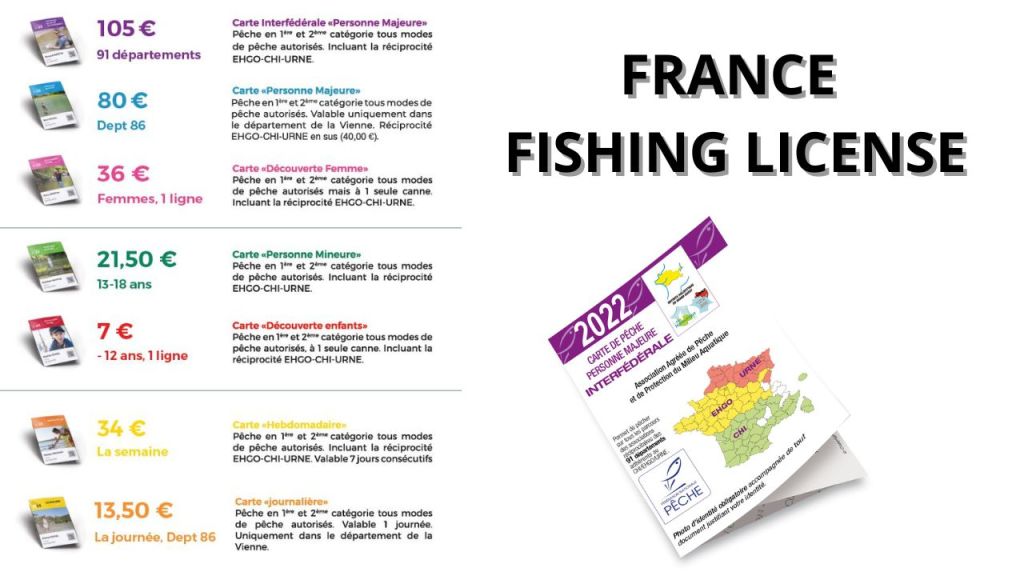
To be able to fly fish in France you only need a fishing license. Each Department has its own license that you can buy online, in bookstores or small convenience stores. There’s also an “interfederal” license that costs €100 that will allow you to fish in the 91 Departments of France.
For example, in the Haute-Garonne, the price of the annual fishing license for an adult is €77, for those under 18 years of age it’s €21, and the price for a single day of fishing is €15.
In France, unlike other countries such as Spain, there are no limited or private areas in which special fishing permits are necessary in addition to the fishing license.
Fishing without having a fishing license in the country is penalized with a fine of €450 and they also confiscate your fishing gear.
THE BEST LODGES AND ACCOMMODATIONS FOR ANGLERS
In France, there are no exclusive lodges dedicated solely to fly-fishing enthusiasts. Until the establishment of our company, there were also no companies offering all-inclusive fly-fishing vacation packages.
At Fly Fishing France, we have cultivated a symbiotic relationship with two exceptional hotels located in Chamonix and Gap, aiming to provide extraordinary fly-fishing vacations in northern France. The selection of these hotels was based on their service quality, facilities, attentive staff, and excellent locations for fly-fishing.
The geographical distribution of our two fly-fishing lodges is as follows:

If you’re looking for more information on fly-fishing lodges in France, visit the following place:
EXPERT GUIDES TO ENHANCE YOUR FLY FISHING ADVENTURE
To become a fly-fishing guide in France, one must possess certification, liability and casualty insurance, and be registered as a company. In our case, to offer comprehensive packages including accommodations, transfers, and guided services, we have established ourselves as a travel agency.
It is crucial for anglers to ensure they hire a legally recognized fishing guide, such as ours. Professionals aspiring to work as fishing guides must hold the recreational fishing guide-instructor certificate issued by the Ministry of Youth, Sports, and Agriculture. Alternatively, they may possess a certificate indicating engagement in this activity before the year 2003.
Many fishing guides in France have united under a professional trade union organization (SMPGF) established in 2019, comprising over 2,000 professionals. This union aims to promote, develop, and defend the fishing guide profession.
In addition to highlighting the assurances of hiring a legal guide in France, we present four compelling reasons why it is important to engage a guide during your trip to the land of the Eiffel Tower:
- Your leisure time is valuable: Fly-fishing guides in France are seasoned professionals who select the best fishing areas, offer advice on flies and techniques, ensuring you catch more fish.
- Unique experience: Guides take you to picturesque locations, arrange excellent riverbank lunches, explore less-frequented fishing spots, and entertain you with stories and humor for a truly memorable experience.
- River safety: Many trout-filled rivers in France are situated in remote, rugged areas with whitewater or reservoir regulations. Fishing guides are well-versed in the risks associated with each river, avoiding unnecessary exposure, and equipped with first aid training.
- Skill enhancement: Fishing guides excel in communication, patience, and teaching. They help you refine your technique or adapt it to the nuances of fishing in a new destination, considering variations in trout behavior based on the country, time of year, and surroundings.
EXPLORING SALTWATER FLY FISHING ALONG THE FRENCH COAST
For enthusiasts of saltwater fly fishing, it’s important to note that France is generally not considered an ideal destination unless you visit French Guiana, especially the Guadeloupe Archipelago or Polynesia. As widely known, prime locations for saltwater fly fishing are found in the Caribbean, and the geographical location of most of France doesn’t allow for fly fishing for species such as bonefish, permit, tarpon, among others.
Nevertheless, in the regions of Brittany and Normandy along the Atlantic coast and in the Mediterranean, it is possible to fly fish for species like sea bass, mahi-mahi, or Little tunny. Local anglers targeting these species often use kayaks, hire fishing charters, and in some very specific locations, fish from the shore.
It’s important to emphasize that in France, there are no fishing guide companies offering services in saltwater. Therefore, if you plan to fish in these locations, it is recommended to bring your own equipment and flies.
An exception to this is Guadeloupe, an archipelago in the Caribbean that forms an overseas region of France. This place is a hidden gem for fly fishing. Despite being a popular tourist destination, it remains relatively unknown in fly fishing circles. Guadeloupe offers diverse environments and species, from tarpon in mangroves to bonefish and snappers in the flats. Fishing equipment recommendations range from 7wt to 10wt, depending on the target species.
ESSENTIAL TECHNIQUES TO IMPROVE YOUR FLY FISHING SKILLS
In France, dry fly fishing is ideal thanks to the extensive daylight hours and favorable climate, allowing for hatches and surface feeding throughout the year. Although nymph fishing is more effective at certain times and months. A notable aspect of fly fishing in France is that the high fishing pressure in some rivers has made the trout extremely selective. These challenges, coupled with France’s rich angling tradition, have propelled the country to stand out as a global powerhouse in fly fishing.
Examining the results of the World Fly Fishing Championships organized by the Confédération Internationale de la Pêche Sportive (FIPS Mouche), it is evident that the French team ranks first with 10 gold medals, 11 silver medals, and 6 bronze medals. Additionally, Pascal Cognard from France is considered the world’s best fly fisherman with a total of 3 gold medals and one bronze, followed by his compatriot Julien Daguillanes.
The abundance of rivers and the “extreme difficulty” of some of them make France a breeding ground for champions; here, the world’s best anglers and the most sophisticated fly fishing techniques converge.
One of the most famous and effective fly fishing techniques is Euro Nymphing. Originating in France and perfected by Spanish anglers, this technique differs by employing a thin monofilament leader instead of a fly line, equipped with a strike indicator. Advantages include sensitivity in fast currents, precise casts, more intensive fishing, a lower likelihood of spooking fish, and the ability to guide flies to a specific depth with small patterns. Moreover, this technique utilizes very light equipment and longer rods.
Another technical aspect for which France stands out is the use of CDC (Cul de Canard) flies. Marc Petit Jean was one of the pioneers in using this material, known for its incredible effectiveness in tying dry flies, nymphs, and streamers. CDC feathers are characterized by:
- Adaptability and lightness, with solid and resilient fibers. Unlike some materials like rooster hackle, CDC feathers can be trimmed without affecting their properties. Semi-translucent, flies tied with CDC appear more realistic than those with more opaque materials.
- High aerodynamics; during the cast, CDC deforms and quickly regains its original shape upon landing, creating a parachute effect. This facilitates casting and provides a more discreet landing. Additionally, in terms of hydrodynamics, CDC deforms both underwater and in the air. Tiny air bubbles entering the fibers generate a notably realistic effect.
- The softness of CDC feathers prevents fish from being alarmed when attacking the fly, crucial in nymph and streamer fishing, reducing rejections compared to setups made with stiffer materials.
FREQUENTLY ASKED QUESTIONS ABOUT FLY FISHING IN FRANCE
What do I need for fly fishing in France?
To engage in fly fishing in France, you must obtain a license for the department you plan to visit. You can make the purchase on the website www.cartedepeche.fr. Additionally, be aware of the interdepartmental fishing license. It is also necessary to familiarize yourself with fishing regulations, which include fishing seasons, permitted fishing days, authorized flies, and restricted fishing locations.
How much does a fishing license cost in France?
The cost of a fishing license in France varies by department. The Interdepartmental Fishing License is priced at €105, while the departmental fishing license costs €80. Discounts are available for other groups such as women, retirees, children, and individuals with disabilities. For instance, the fishing license for children under 12 years old has a reduced cost of only €7.
Can non-residents fly fish in France?
Yes, non-residents can fly fish in France. They need to obtain a fishing license, the cost and requirements of which may vary by region. It is essential to comply with local regulations and obtain the appropriate permits for specific fishing locations.
Are the Alps the best destination for fly fishing in France?
The Alps, Pyrenees, and Central Massif are considered the prime destinations for fly fishing in France. However, the Alps stand out, particularly for the beauty of their mountains and the variety of landscapes and species they offer, such as brown trout, brook trout, grayling, lake trout, and rainbow trout. All of this is experienced in stunning locations like the Ecrins National Park.
Who are the most famous fly fishermen in France?
Among the most prominent fly fishermen in France is Pascal Cognard, regarded as the greatest competition angler in history. Currently, his compatriot Julien Daguillanes stands out, along with the Spaniard David Arcay, as one of the competitors with the most medals in the last 10 years.